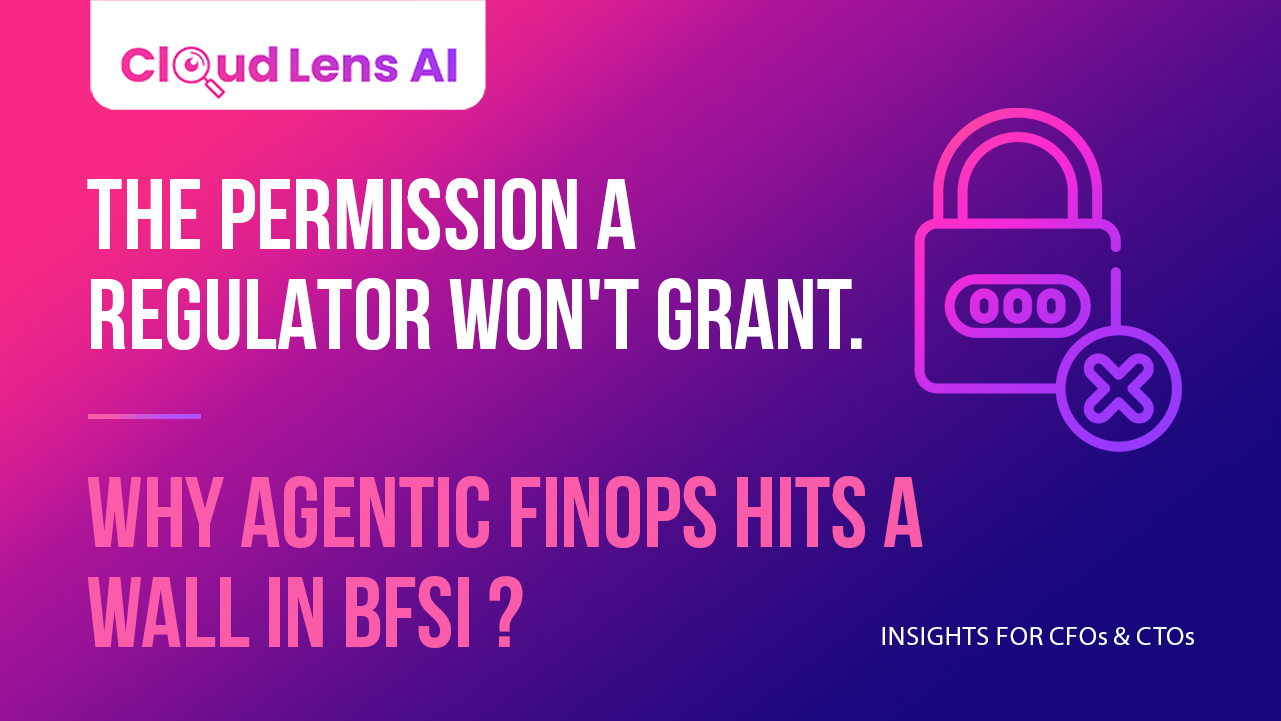
For banks, NBFCs, and other regulated financial institutions, autonomous FinOps is often framed as a trust question: will AI become reliable enough to act on its own? But the deeper barrier is not model capability. It is whether an autonomous operating model can satisfy regulatory requirements for accountability, controlled access, auditability, and human oversight. Better AI may improve accuracy; it does not remove the compliance boundary.
Think of how a bank treats access to a vault. A repair technician is not given a permanent key because they have performed well before. Access is granted for a defined job, limited to what is necessary, and withdrawn when the work is finished. Competence matters, but accountability matters more. An autonomous FinOps agent faces the same problem when it requires persistent or recurring permissions to inspect and act inside a regulated cloud environment.
What the regulator requires
The Reserve Bank of India's 2025 Directions on Managing Risks in Outsourcing make this an operational issue rather than a theoretical one. The framework applies across regulated entities and strengthens safeguards around governance, cloud computing, access controls, auditability, data management, and exit planning. Existing IT outsourcing arrangements were required to comply by April 10, 2026, while new arrangements must comply from inception.
Two principles are especially important. Outsourcing an activity does not outsource the regulated entity's responsibility for it, and supervisory access cannot depend on a vendor's convenience or confidentiality restrictions. Combined with controls around subcontracting and incident reporting, the direction is clear: technology access must remain governable, inspectable, attributable, and revocable.
Cloud best practice points the same way
This logic is consistent with cloud security best practice. AWS Well-Architected guidance emphasizes least privilege and just-in-time access, using temporary credentials and permissions scoped to a specific task. Its Financial Services Industry Lens similarly stresses federation, disciplined credential rotation, and removal when access is no longer required.
In other words, regulated cloud architecture is designed around temporary, scoped, revocable access. That sits uneasily with any model that depends on a standing autonomous agent deciding independently when to intervene. This is why not every category of FinOps solutions creates the same governance exposure.
Why better AI does not solve the problem
It is tempting to assume that this boundary will disappear as agentic AI becomes more reliable. It will not disappear simply because the model improves. Reliability can reduce the probability of a poor decision; it cannot determine who is institutionally accountable, who authorized the action, or how authority is withdrawn.
Yet regulated institutions still need visibility into cloud spending. The challenge is therefore not whether to use cloud intelligence, but how to obtain persistent access before the institution has even decided what action should be taken.
Agentless FinOps changes the starting point
This is where Agentless FinOps has a structurally different fit. Instead of beginning with credentials, live integration, or standing access, the assessment can begin with billing and usage data the organization already has. Diagnosis comes before intervention.
For Cloud Lens AI, that means billing data can be assessed quickly to surface spending patterns, inefficiencies, and potential reinvestment opportunities without entering the live cloud environment. Finance, cloud, and technology teams can review the diagnosis together, while any remediation remains a deliberate human decision.
This separation is especially important in BFSI. It allows an institution to understand where money is going and what deserves attention before granting privileged access to production infrastructure. AI provides speed at the diagnostic layer; human judgement remains responsible for what happens next.
The shortlist starts with architecture
For a CFO or CTO in a regulated institution, this reframes from vendor selection. The first question is not, “Which autonomous agent do we trust most?” It is, “Which operating model gives us useful cloud intelligence while preserving the governance, access, and accountability model we are required to maintain?”
In less regulated environments, agentless architecture may look like a convenience or security preference. In BFSI, it can be more fundamental: a way to separate diagnosis from privileged execution so cloud cost optimization can begin without making persistent access to the price of visibility. The future of FinOps in regulated industries will therefore depend not on AI capability alone, but on how effectively AI speed is combined with human judgement and institutional accountability.
Ready to see what your next diagnostic would show?
Run an agentless FinOps diagnostic from just your AWS bill. No access, no integration.
Book a diagnostic at cloudlensai.com.
Sources
- Reserve Bank of India, Directions on Managing Risks in Outsourcing, 2025
- AWS Well-Architected Framework, Security Pillar (SEC03-BP02, SEC03-BP09)
- AWS Financial Services Industry Lens, Well-Architected Framework